15 High-Calorie Snacks for Weight Gain on the Go
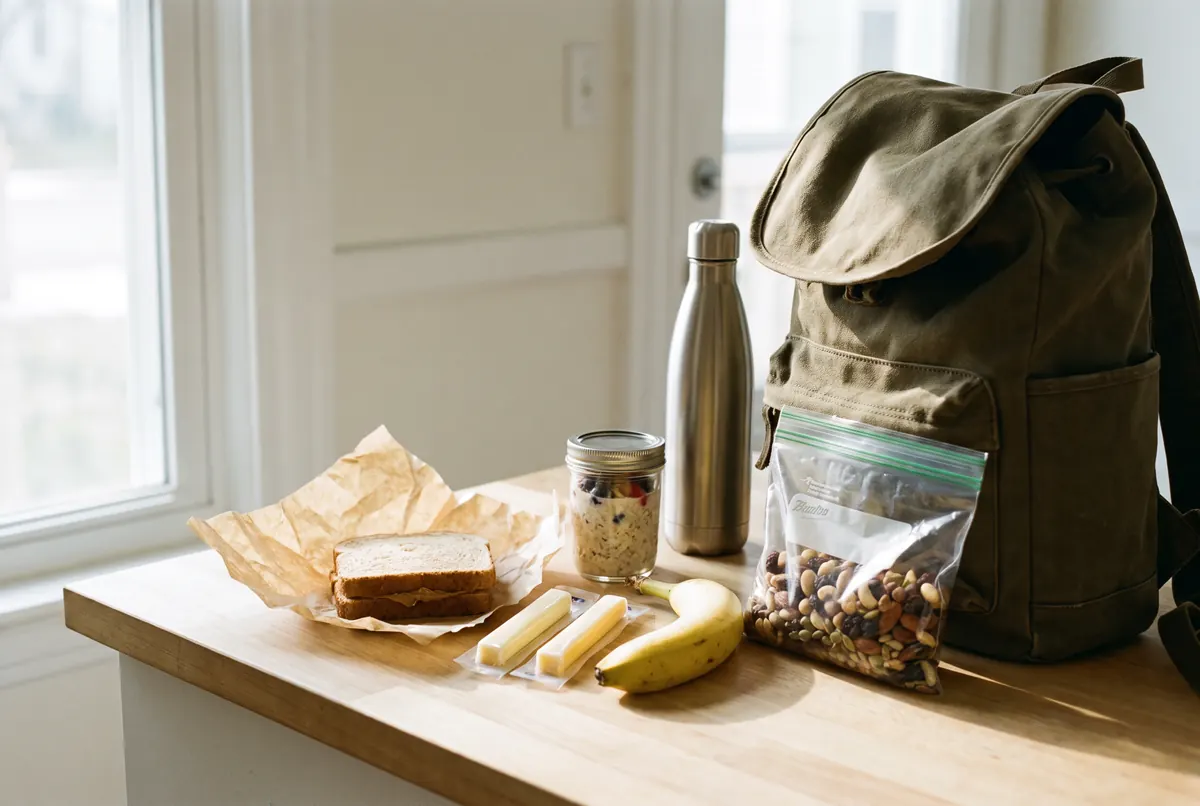
The best high-calorie snacks for weight gain on the go are small, heavy for their size, and easy to carry. Nuts, seeds, and peanut butter lead the list, because each packs about 165 to 200 calories into a single ounce. Dried fruit and jerky round out the ready-to-carry group, and a peanut butter sandwich takes two minutes to make ahead. Cheese, eggs, and yogurt add protein but are perishable, so they need a fridge nearby.
This page compares 15 snacks side by side. Every calorie and protein number comes from USDA food data for the stated portion, and the allergen notes use the nine major food allergens the FDA lists. Your own brand’s label is the final word, since recipes and portion sizes vary between products.
Why high-calorie snacks matter for weight gain
A calorie surplus means eating more calories than your body burns, day after day. For many people trying to gain, the meals are not the hard part; the long gaps between them are. A snack in your bag turns a commute, a class, or a work shift into part of the plan, and three 200-calorie snacks add 600 calories without making any meal bigger.
Your daily target decides how many snacks you need. Get it from the calorie surplus calculator, then use the tables below to fill whatever gap your meals leave.
How to read the tables
- Portion is the amount the calories are for, so if you change the portion, the calories change with it.
- Calories per ounce is calories per ounce of food weight. It shows how much energy you carry for the space and weight in your bag, and a higher number means a denser snack.
- Allergens lists which of the FDA’s nine major food allergens the food itself contains. Packaged foods can add others or be made in shared factories, so always read the label.
Ready to carry: no prep
| Snack | Portion | Calories | Protein | Calories per ounce | Allergens |
|---|---|---|---|---|---|
| Pecans, dry roasted | 1 oz | 201 | 2.7 g | 201 | Tree nuts |
| Mixed nuts with peanuts, oil roasted, salted | 1 oz | 172 | 5.7 g | 172 | Peanuts, tree nuts |
| Peanut butter (single-serve pack or jar) | 2 tbsp (32 g) | 191 | 7.1 g | 170 | Peanuts |
| Sunflower seed kernels, dry roasted | 1 oz | 165 | 5.5 g | 165 | None of the nine |
| Hard granola bar, plain | 1 oz bar | 134 | 2.9 g | 134 | Varies by brand, read the label |
| Beef jerky | 1 oz | 116 | 9.4 g | 116 | None in the meat, read the label |
| Raisins | 1.5 oz box | 129 | 1.4 g | 85 | None of the nine |
| Medjool dates | 3 dates | 199 | 1.3 g | 79 | None of the nine |
| Banana | 1 medium | 105 | 1.3 g | 25 | None of the nine |
Nuts and seeds win on density. An ounce of pecans weighs the same as an ounce of raisins, but it carries more than twice the calories, so nuts are the pick when bag space is tight. If you want something sweet, pair dried fruit with nuts rather than eating it on its own.
Jerky is the protein pick of this group, with about 9 grams an ounce, but it is not very dense for calories, so pair it with nuts to get both. One labeling note matters here: the federal allergen labeling law the FDA enforces does not cover most meats, which other agencies regulate. That means you should read jerky’s full ingredient list rather than looking only for a “Contains” line. Jerky is a meat product, and meat is on the CDC list of perishable foods, so store jerky exactly as its package says. The other foods in this table are not on that list. Keep granola bars as labeled, and keep the banana whole until you eat it.
Make ahead: a few minutes of prep
| Snack | Portion | Calories | Protein | Calories per ounce | Allergens |
|---|---|---|---|---|---|
| DIY trail mix | 1/2 cup mixed nuts + 1/4 cup raisins | 515 | 14.6 g | 141 | Peanuts, tree nuts |
| Peanut butter sandwich | 2 slices white bread + 2 tbsp peanut butter | 346 | 12.2 g | 109 | Peanuts, wheat; bread may add others |
These two carry the most calories per snack on the page. The trail mix bag is about 515 calories, and you can mix a week of bags on Sunday and grab one each morning. The sandwich takes about two minutes to make. Store the bread and peanut butter the way their labels say.
Needs a fridge: perishable
| Snack | Portion | Calories | Protein | Calories per ounce | Allergens |
|---|---|---|---|---|---|
| Cheddar cheese | 1.5 oz | 171 | 9.7 g | 114 | Milk |
| Plain Greek yogurt, whole milk | 6 oz | 165 | 15.3 g | 27 | Milk |
| Hard-boiled eggs | 2 large | 155 | 12.6 g | 44 | Eggs |
| Whole milk | 1 cup | 149 | 7.7 g | 17 | Milk |
These are the protein-rich options, but they are perishable. The CDC’s rule is simple: never leave perishable food out for more than 2 hours, or 1 hour when it is above 90°F. So carry them only when you will eat them or get them into a fridge within that time, or save them for places where you have a fridge. The CDC says bacteria multiply fast between 40°F and 140°F, and a fridge should be at 40°F or below. If you boil eggs ahead for the week, the FDA says to eat them within a week of cooking.
Yogurt, eggs, and milk have low calories per ounce because they hold a lot of water. That is fine at a desk with a fridge nearby, but it is a poor trade in a bag where every ounce counts. Cheddar is the exception: at 114 calories per ounce, it is about as dense as jerky.
Building a day of snacks
Here is one way to add close to 1,000 calories without cooking anything extra:
- Morning: a DIY trail mix bag (515)
- Afternoon: a peanut butter sandwich (346)
- Anytime: a banana on the way out the door (105)
That is 966 calories from three snacks, and you can scale it up or down to match your calculator number.
If carrying food is not the issue and fullness is, start with the small appetite guide and how to eat more without feeling sick. For snacks you can drink at home, try the homemade mass gainer shake. To keep the snack budget low, the cheap high-calorie foods list shows how to price any bag by cost per 1,000 calories. More ideas live in the nutrition hub.
Frequently asked questions
What is the most calorie-dense snack to carry?
Of the snacks compared here, dry-roasted pecans pack the most calories into the least weight: about 201 calories per ounce by USDA data. Mixed nuts, peanut butter, and sunflower seeds follow at about 165 to 172 calories per ounce. Nuts and seeds are the best choice when bag space is tight.
Which high-calorie snacks need a fridge?
The CDC lists meat, seafood, dairy, cut fruit, some vegetables, and cooked leftovers as perishable food. Of the snacks here, that covers jerky, cheese, yogurt, and milk. Jerky is a meat product, so store it exactly as its package says. The FDA gives the same time limits for cooked eggs, so keep hard-boiled eggs cold too. Carry a banana whole rather than cut. For granola bars, nuts, and peanut butter, follow the storage directions on the label.
What are good high-calorie snacks without nuts or peanuts?
Sunflower seeds, Medjool dates, raisins, and bananas contain none of the nine major food allergens the FDA lists, though packaged versions can be made alongside nuts, so read the label. Cheese and yogurt are nut-free but contain milk. Beef jerky has no major allergens in the meat itself, but check the ingredient list for flavorings.
This is educational content, not medical advice. Talk with your doctor before changing your diet, exercise, or supplements, especially for teens, adults over 65, or anyone managing a health condition or taking medication. Full medical disclaimer.
Sources
- USDA FoodData Central (SR Legacy): Calories and protein per 100 grams and serving weights for every snack in the table: pecans dry roasted 710 kcal (FDC 170183), mixed nuts oil roasted with peanuts, salted, 607 kcal with 1/2 cup at 67 g (168600), sunflower seed kernels dry roasted 582 kcal (170563), smooth peanut butter 598 kcal with 2 tbsp at 32 g (172470), beef jerky 410 kcal (167536), hard plain granola bar 471 kcal (167542), raisins 299 kcal with a small box at 43 g and 1 cup at 145 g (168165), Medjool dates 277 kcal at 24 g each (168191), banana 89 kcal with a medium at 118 g (173944), cheddar 403 kcal (173414), hard-boiled egg 155 kcal at 50 g each (173424), whole-milk plain Greek yogurt 97 kcal (171304), whole milk 61 kcal with 1 cup at 244 g (171265), white bread 266 kcal at 29 g per slice (174924).
- U.S. Food and Drug Administration, Food Allergies: What You Need to Know: The nine major food allergens are milk, eggs, fish, crustacean shellfish, tree nuts, peanuts, wheat, soybeans, and sesame, and the federal allergen labeling law FDA enforces does not cover most meats, which other agencies regulate.
- Centers for Disease Control and Prevention, Four Steps to Food Safety: Never leave perishable food out for more than 2 hours, or 1 hour if it is exposed to temperatures above 90°F. Perishable food is listed as meat, seafood, dairy, cut fruit, some vegetables, and cooked leftovers, bacteria can multiply rapidly in the Danger Zone between 40°F and 140°F, and a refrigerator should be kept at 40°F or below.
- U.S. Food and Drug Administration, What You Need to Know About Egg Safety: Never leave cooked eggs out of the refrigerator for more than 2 hours, or more than 1 hour when temperatures are above 90°F, and use hard-cooked eggs within 1 week after cooking.